





DDC vs D5 Pumps: Which Should You Choose?
If you have spent any time researching custom watercooling, you will have encountered two pump names over and over again: the DDC and the D5. Both were originally designed by Laing in Germany, and between them they have powered virtually every custom loop built in the last two decades. But which one is right for your build? That is precisely what we are here to break down. Let’s get into it.
A Bit of Background
Both pumps were designed by Laing GmbH, a German engineering firm responsible for the spherical motor technology that makes these units so reliable. Laing was acquired by ITT Corporation in 2009, which then spun off its water division as Xylem Inc. in 2011. As such, when you see pumps branded as Laing, Lowara, or Xylem, they are all the same thing.
The reason these two dominate is fairly straightforward. The wet rotor design uses the coolant itself to lubricate the only moving part (the impeller), so there are no mechanical seals to wear out or leak. With a rated lifespan of 50,000+ hours, a well-maintained D5 or DDC will comfortably outlast most of the components it is cooling.
You will see both pumps sold under various brand names. EK, Alphacool, Watercool, Barrow, and others all make their own housings and combo units, but the actual pump motor inside is almost always a genuine Xylem unit.
The DDC: Compact and Powerful

- SKU: 49135
- MPN: 13914
- EAN: 4049469175511
- Available for Collection
- SKU: 49065
- MPN: 6500043
- EAN: 4049469056827
- Available for Collection
- SKU: 49064
- MPN: 6500023
- EAN: 4049469056810
- Available for Collection
- SKU: 1019539
- MPN: 13991
- EAN: 4250197139915
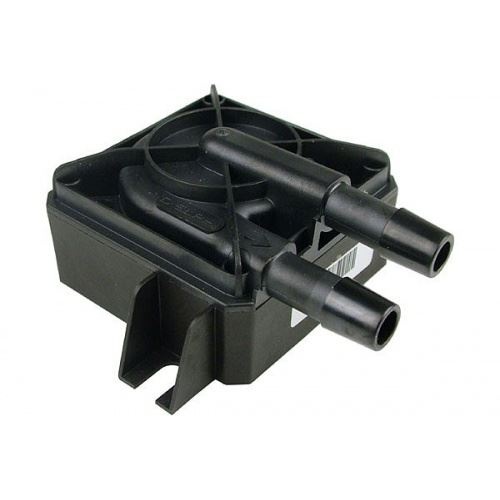
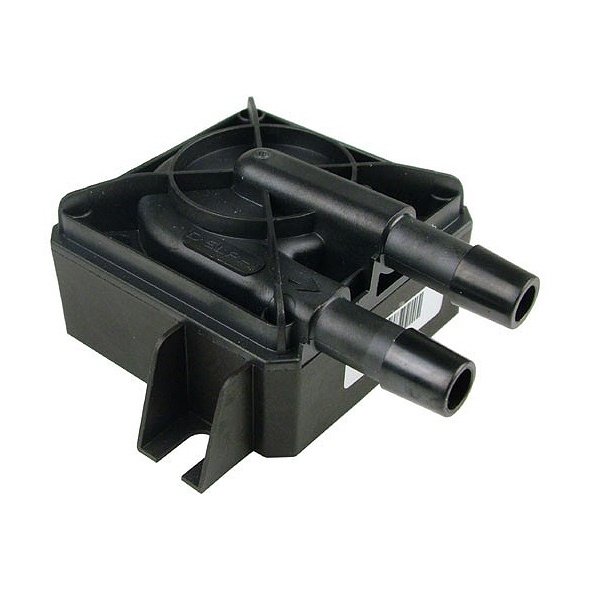
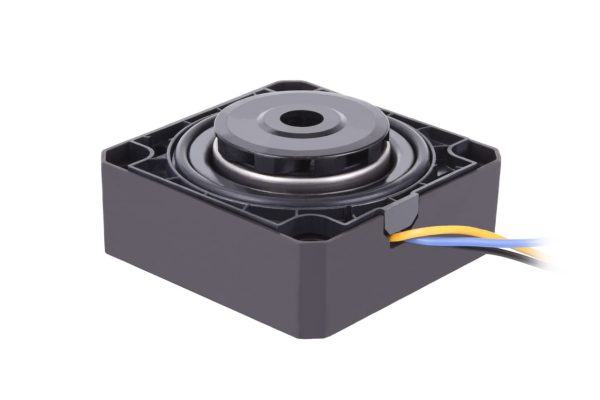
The DDC is the smaller of the two, roughly 62 x 62 x 38mm for the bare motor. It is about half the size of a D5, which makes it the go-to choice for small form factor builds and distribution plates.
What the DDC lacks in size, it makes up for in head pressure. At around 5.2 metres (and up to 7 metres on the DDC 3.25 variant), it pushes coolant through restrictive loops quite comfortably. If you are running multiple water blocks with tight micro-channels, a DDC will not struggle.
The trade-off is noise. At full speed, the DDC produces a noticeable high-pitched whine. I would describe it as “a bit whiny,” to put it plainly. At lower speeds (below 2000 RPM via PWM control), it is virtually silent, but crank it up and you will hear it. The other thing to know is that the DDC is air-cooled, not water-cooled like the D5. That means a heatsink is strongly recommended, and most aftermarket DDC pump tops include one.
The D5: Quiet and Versatile
- SKU: 1027969
- MPN: 30061
- EAN: 4251312607494
- Available for Collection
- SKU: LF-PMP001
- MPN: 608500003
- EAN: 5060684862146
- Available for Collection
- SKU: LF-PMP002
- MPN: 6085C2015
- EAN: 5060684862153
- Available for Collection
- SKU: WAEK-2230
- MPN: 3831109848494
- EAN: 3831109848494
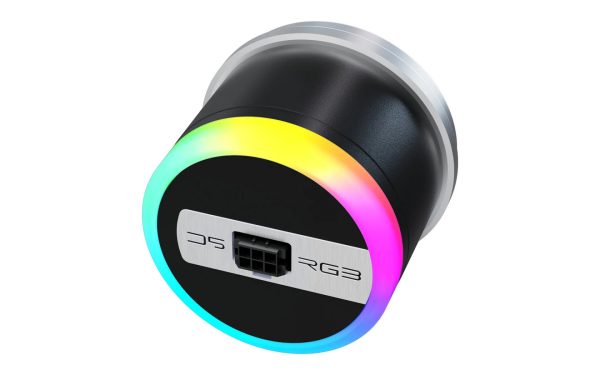
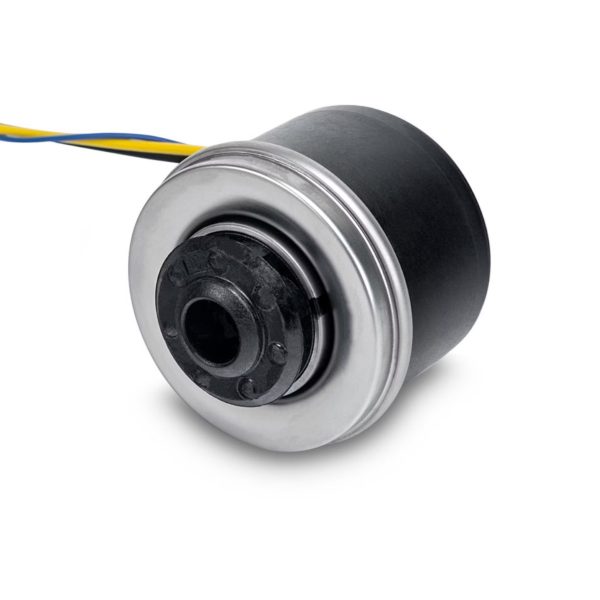
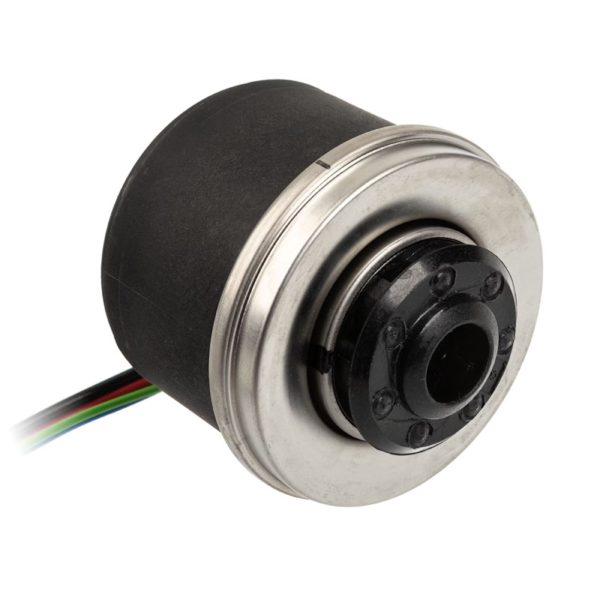
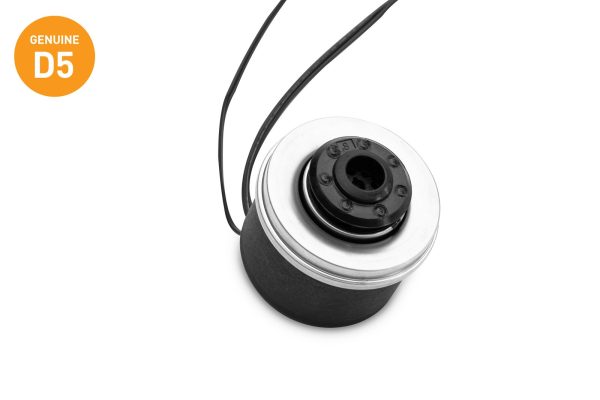
The D5 is the larger pump at roughly 66mm diameter by 57mm tall, about twice the volume of a DDC. It is the default choice for most standard ATX builds, and for good reason.
Where the D5 excels is noise and flow rate. It pushes up to 1500 L/h (compared to the DDC’s 1000 L/h) and does it more quietly. The D5 produces a low-frequency hum rather than the DDC’s whine, and at typical operating speeds (40-60% PWM) it is barely audible inside a closed case. At 35% PWM, most people cannot hear it at all. In short, if noise is a priority, the D5 is quite impressive in this regard.
The D5’s motor is cooled by the liquid it is pumping, so no heatsink is needed. This also means it runs cooler overall, which contributes to its excellent longevity.
Head pressure is lower than the DDC at around 3.9 metres, but for the vast majority of loops (a CPU block, a GPU block, a couple of radiators), that is more than enough.
The D5 comes in two speed control variants: PWM (controlled via a 4-pin motherboard header, adjustable in software) and Vario (a manual 5-position dial on the back). Performance is identical between the two. It is just a matter of how you prefer to control the speed.
Head Pressure vs Flow Rate
This is the question that trips most people up, so let us keep it simple.
Flow rate is how much coolant moves through the loop per hour. More flow means coolant spends less time absorbing heat at the water block and more time shedding it at the radiator. The D5 wins here with 1500 L/h vs the DDC’s 1000 L/h.
Head pressure is the pump’s ability to push through restrictions. Every water block, radiator, fitting, and bend adds resistance. The DDC wins here with 5.2 metres vs the D5’s 3.9 metres.
In practice, the difference matters less than you might think. Once you have got reasonable flow (above about 0.5 GPM), adding more flow only improves temperatures by 1-2°C. For a standard loop with a CPU block, GPU block, and one or two radiators, either pump will do the job perfectly well.
Where head pressure really matters is in highly restrictive loops: multiple GPU blocks, lots of 90-degree fittings, flow meters, and long tubing runs. That is where the DDC earns its keep.
Pump Tops and Combo Units
- SKU: 1023976
- MPN: 13742
- EAN: 4250197137423
- Available for Collection
- SKU: XS-PMP-020
- MPN: 5060596651906
- EAN: 5060596651906
- Available for Collection
- SKU: XS-PMP-010
- MPN: 5060596651661
- EAN: 5060596651661
- Available for Collection
- SKU: 1019187
- MPN: 13327
- EAN: 4250197133272
Both pumps have a huge ecosystem of aftermarket accessories. The bare pump motor is just the starting point. You will want a pump accessory such as a pump top (which provides the G1/4 inlet and outlet ports) and often a reservoir to go with it.
DDC pump tops from brands like Watercool (Heatkiller), EK, and Alphacool replace the stock plastic top with higher-quality acetal or acrylic alternatives, usually with an integrated heatsink. It is worth noting that all DDC tops are cross-compatible with any DDC motor. That is a nice touch.
D5 pump tops from Watercool, EK, Singularity Computers, and others offer the same upgrade path. The Aqua Computer D5 NEXT deserves a special mention as it integrates temperature and flow monitoring sensors directly into the pump. Quite swish, if you ask me.
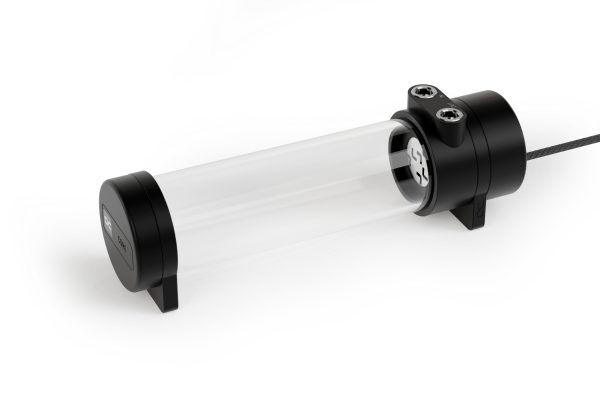
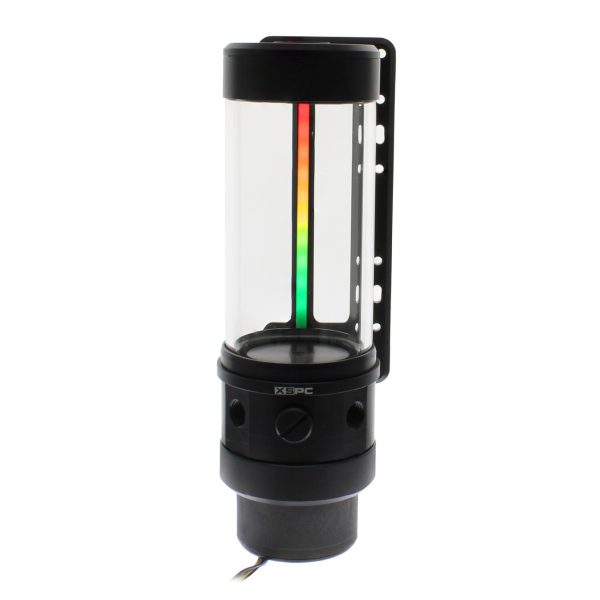
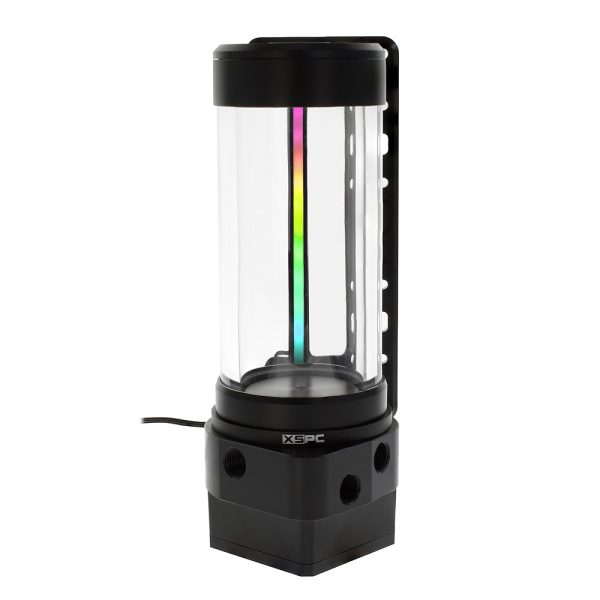
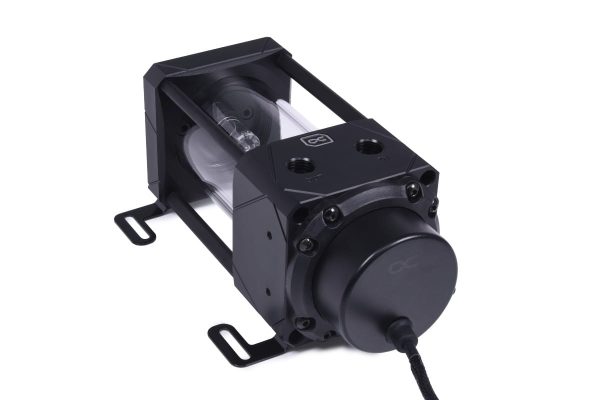
Pump reservoir combos are the most popular option for both pumps. These combine the pump and reservoir into a single unit, simplifying the build significantly. They are available as tube-style or flat (FLT) designs.
Which Should You Choose?
Go DDC if:
- You are building in a small form factor or ITX case
- You are using a distribution plate (almost all use DDC seats)
- Your loop is highly restrictive (3+ water blocks, lots of fittings)
- Space is your primary constraint
Go D5 if:
- You are building in a standard ATX PC case
- Noise is a priority (the D5 is noticeably quieter)
- You want a simple, reliable “set and forget” pump
- Your loop is relatively straightforward (CPU + GPU + 1-2 radiators)
Either pump works fine for:
- Standard dual-block loops (CPU + GPU)
- Single radiator or dual radiator setups
- Most builds where space is not extremely tight
On a subjective note, if you are unsure and your case has the room, I would say go with a D5. It is the safer choice for the majority of builds, it is quieter, and the slightly lower head pressure will not matter for a typical loop. Save the DDC for when you genuinely need the compact size or the extra pressure.
A Word on Dual Pump Setups
You will occasionally see builds with two pumps. For 99% of builds, a single pump is more than enough. If you do want to run dual pumps (for a very large or complex loop), run them in series (one after the other), not in parallel. In series, the head pressures add together, which directly combats the restriction in your loop. Parallel setups offer minimal benefit in watercooling because the restriction is too high for the flow increase to matter.
It is worth being aware of diminishing returns, though. The second pump adds maybe 30% more flow. A third adds about 15%. For most people, a single good pump is all you need.
Looking After Your Pump
Whichever pump you choose, the maintenance rules are the same:
- Never run it dry. Both pumps use fluid-lubricated bearings.
- Use proper coolant with corrosion inhibitors and biocide.
- DDC-specific: make sure it has adequate airflow or a heatsink.
- Change your coolant regularly to prevent build-up on the impeller.
- Listen for changes in noise. Grinding, clicking, or rattling means something needs attention.
For those building their first custom loop, either pump will serve you well. The D5 is the quieter, more forgiving option for standard builds, and I do think it is the better starting point for most people. The DDC, however, is not to be underestimated. Its compact size and superior head pressure make it indispensable in space-constrained or highly restrictive setups. Whichever you go with, proper maintenance and decent coolant will keep it running for years. It is one of those decisions where, provided you match the pump to your build’s requirements, there is not really a wrong answer.