







AMD introduces the R7 and R9 of two new graphics cards series, replacing the Radeon HD series. The different models are doing all players - from casual gamers to hardcore enthusiasts - satisfy.
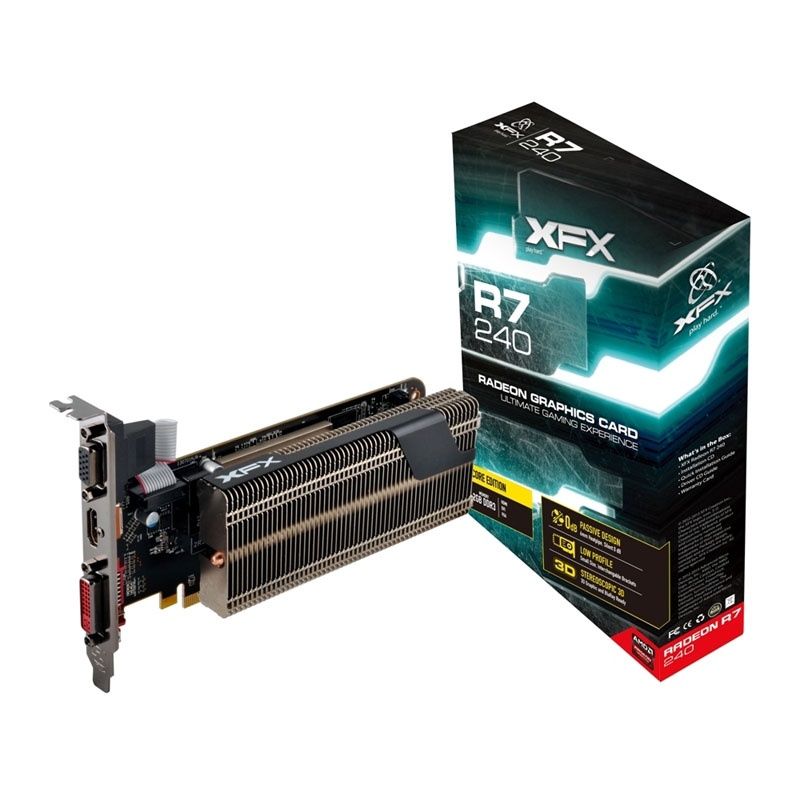
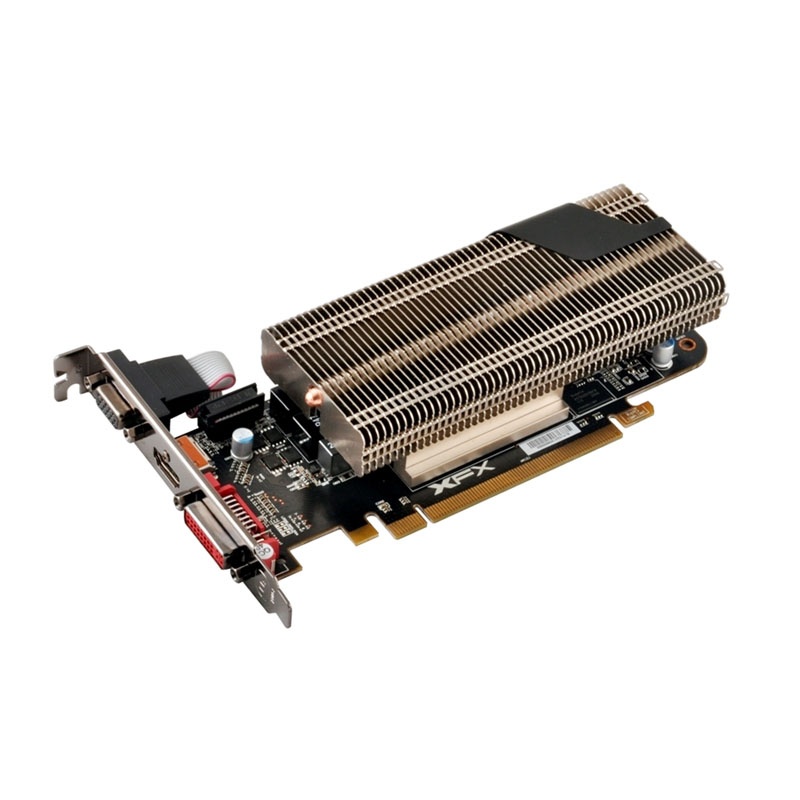
With the XFX Radeon R7 240 in the Passive Low Profile Edition with 2 GB of DDR3 memory appears an affordable entry into the R7 series. The map arranges itself in terms of performance in around the level of the HD 6570. The graphics card comes in a single-slot format and has a passive heatsink without a fan, which makes them particularly suitable for small housing.
XFX Radeon R7 240, 780m Passive Low Profile Edition, 2048MB DDR3
AMD introduces the R7 and R9 of two new graphics cards series, replacing the Radeon HD series. The different models are doing all players - from casual gamers to hardcore enthusiasts - satisfy.
With the XFX Radeon R7 240 in the Passive Low Profile Edition with 2 GB of DDR3 memory appears an affordable entry into the R7 series. The map arranges itself in terms of performance in around the level...

- SKU: GCXF-109
- MPN: R7-240A-CLH4
- EAN: 0778656063174
- Warranty: 12 Months
AMD introduces the R7 and R9 of two new graphics cards series, replacing the Radeon HD series. The different models are doing all players - from casual gamers to hardcore enthusiasts - satisfy.
With the XFX Radeon R7 240 in the Passive Low Profile Edition with 2 GB of DDR3 memory appears an affordable entry into the R7 series. The map arranges itself in terms of performance in around the level...
Featured products
No products found
The GPU is clocked at the XFX Radeon R7 240 up to 780 MHz maximum boost and memory with 1600 MHz (3200 effective). The RAM is connected two gigabytes in size, and a 128-bit interface.
The bandwidth in communication between the graphics card and motherboard or CPU falls high out, because the XFX Radeon R7 240 brings the latest interface standard PCI Express 3.0 with it, thus – with suitable residual Hardware – the bandwidth over PCIe 2.0 to 16 GB / s doubles.
The XFX Radeon R7 240 is already on DirectX 11.2, OpenGL 4.3 and also supports OpenCL 1.2. The map controls to monitors via a DVI-D and a HDMI port and a VGA port, where one or more graphics cards can be linked together via CrossFireX, to take over the (3D) representation together. With the XFX Radeon R7 240, output on two screens simultaneously possible. The power is supplied via the PCI port. A 6-pin or 8-pin PCIe connector is not required.
In order to realize the full potential of the card in the future, new drivers should (formerly ATI) or MSI be downloaded and installed at regular intervals of AMD.
Technical Details:
Dimensions: 68.8 x 38.1 x 177 mm (W x H x D)
Height: 1-Slot
GPU: AMD Radeon R7 240
Type: Oland
Manufacturing process: 28 nm
GPU Clock: 780 MHz (. Maximum boost)
Shader units: 320
Memory Size: 2048 MB
Memory clock: 1600 (3200) MHz
Type: DDR3
Memory interface: 128-bit
Slot: PCIe x16 (PCI / PCIe 2.x / PCIe 3.0)
connections:
1x HDMI 1.4a
1x Single-Link DVI-D
1x D-Sub (VGA)
Power supply: PCIe Slot
Features: DirectX 11.1, OpenGL 4.3, CrossFireX, HD3D support
Compatibility (operating system): Windows 8, 7
