







With the Llano processor in its A-series AMD introduced in summer 2011, a new in-house concept to the market: the APU. The Accelerated Processing Unit united in contrast to classical CPU - for example, the Phenom II or FX processor - in addition to the x86 execution units have a graphics unit on the same die.
This also joins in the past housed on the motherboard Northbridge, so that three components come together on the APU.
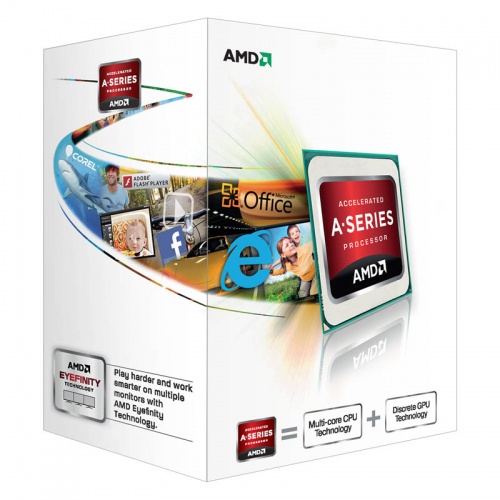
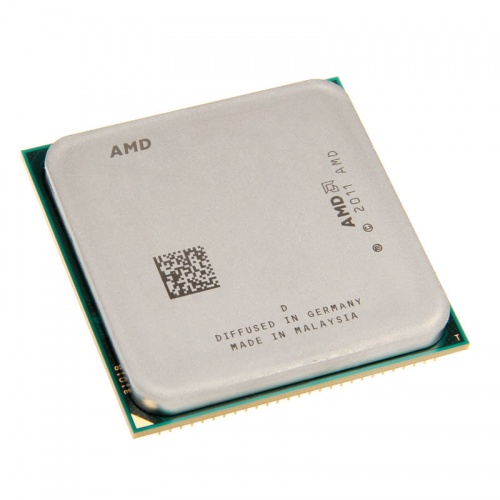
AMD A10-5700, 4-core, 3.4 GHz (Trinity), RADEON HD 7660D - boxed
With the Llano processor in its A-series AMD introduced in summer 2011, a new in-house concept to the market: the APU. The Accelerated Processing Unit united in contrast to classical CPU - for example, the Phenom II or FX processor - in addition to the x86 execution units have a graphics unit on the same die.
This also joins in the past housed on the motherboard Northbridge, so that three compone...

- SKU: HPAM-041
- MPN: AD5700OKHJBOX
- EAN: 0730143301824
- Warranty: 12 Months
With the Llano processor in its A-series AMD introduced in summer 2011, a new in-house concept to the market: the APU. The Accelerated Processing Unit united in contrast to classical CPU - for example, the Phenom II or FX processor - in addition to the x86 execution units have a graphics unit on the same die.
This also joins in the past housed on the motherboard Northbridge, so that three compone...
Featured products
No products found
What better name than Trinity AMD had now so can give the representatives of the second generation APU? It was already clear to Llanos times that the APU can not compete with conventional processors and do when it comes to the calculation of classical CPU tasks. AMD would therefore break with Trinity in this area no performance records. Much more targeting you to a buyer who wants a very low initial cost, high energy efficiency and a modern all-round system.
Thus, the processors in the A-series in its second generation still offer the most affordable for office and multimedia PCs and provide specifically for small, quiet HTPCs the ideal foundation. Join the Trinity are based on a new architecture as compared to the Llanos of course a lot more powerful. Not least because of the introduction of a new base is necessary, so that the A processor of the second generation FM2 are used, which is not compatible with the previous FM1.
In the 32-nm process made the covers 1.3 billion transistors and sets in the CPU processing units on the Piledriver architecture, a powerful revision of the Bulldozer design, which is also used for the FX processors of the second generation. AMD says the new top models A10 and A8 from increased by up to 13% of processing power in each application, as was the case with the A8-3870K Llano. Unlike its predecessors, the Trinity can also show a load-dependent automatic overclocking (Turbo Core 3.0).
Thus, the base clock of the offered A10-5700 increased from already very fast 3.4 to a whopping 4.0 GHz turbo clock when the thermal reserves (65 watt TDP) permit. The A10-5700 has two Piledriver modules and each module has two cores that share among others each with 2 MB L2 cache. Thus does the A10 APU back to four CPU cores and 4 MB total cache, what they can handle even the most demanding multi-threaded tasks effortlessly.
Much has been done even with the integrated graphics unit, which here has a more modern design for VLIW4 basis. At A10-5700 is the most powerful version called HD 7660D with 384 shader units and 800 MHz operating clock used. According to AMDs graphics and video performance are up to 18% higher than the A8-3870K. Thus, the HD 7660D is even able, less demanding games (also DirectX11) calculate liquid with low detail settings in Full HD – at lower resolutions, the number of frames per second to continue.
If you want to increase the gaming capability with low budget even further, optional * to accept entry-level discrete graphics card from AMD, which then uses the iGPU in Crossfire configuration that AMD Dual Graphics calls. For many users, the actual activity of the A10-5700, however, consist in play HD videos or transcoding to other formats, what the Trinity APUs features UVD 3 and AVC perfectly prepared. Multimedia works (including support for OpenCL) is accelerated and thus more efficiently – all on a single chip!
Even EyeFinity was brought up to date, the one is to expect from the modern Radeon HD 7000 graphics card: it can now, without adding an additional graphics card, up to four monitors with images supplied (one of which will necessarily via DisplayPort ) because the HD-7660D iGPU has four display controller. Of course, the specific connectivity, however, depends on the used motherboard and its connections. With all these features – the cheapest cost, integration into one chip, high energy efficiency and a lot of multimedia power – Trinity builds exactly where Llano has begun.
In this boxed version of the processor includes a matching CPU cooler AMD supplied.
* AMD recommends for the A10 dual graphics a graphics card model Radeon HD 6670 and HD 6570th
Specifications:
Type: AMD A10-5700
Trinity
Manufacturing process: 32 nm
Cores: 4 (2 Piledriver modules)
Clock: 3.4 GHz
Turbo clock (max.): 4.0 GHz
Level-2 cache: 4 MB
Storage Controller: internal
Memory Channels: 2
Memory Standard: DDR3 (up to 1866MHz)
Integrated graphics unit: HD 7660D (384 shader units, 800 MHz)
TDP: 65 Watt
Socket Compatibility: FM2
Special features:
4 cores: very solid desktop performance
4 megabytes of L2 cache
Dual-channel interface
Support for DDR3-1866
Turbo Core 3.0: automatic clock increase
Integrated graphics HD 7660D
UVD 3 (Unified Video Decoder): efficient video playback
AVC (Accelerated Video Converter): fast transcoding
