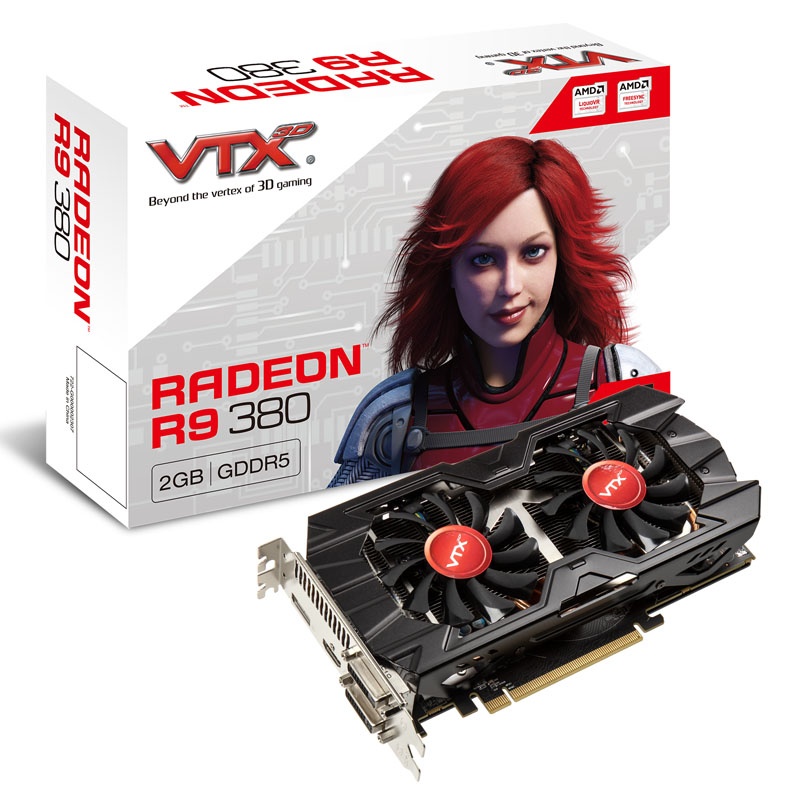
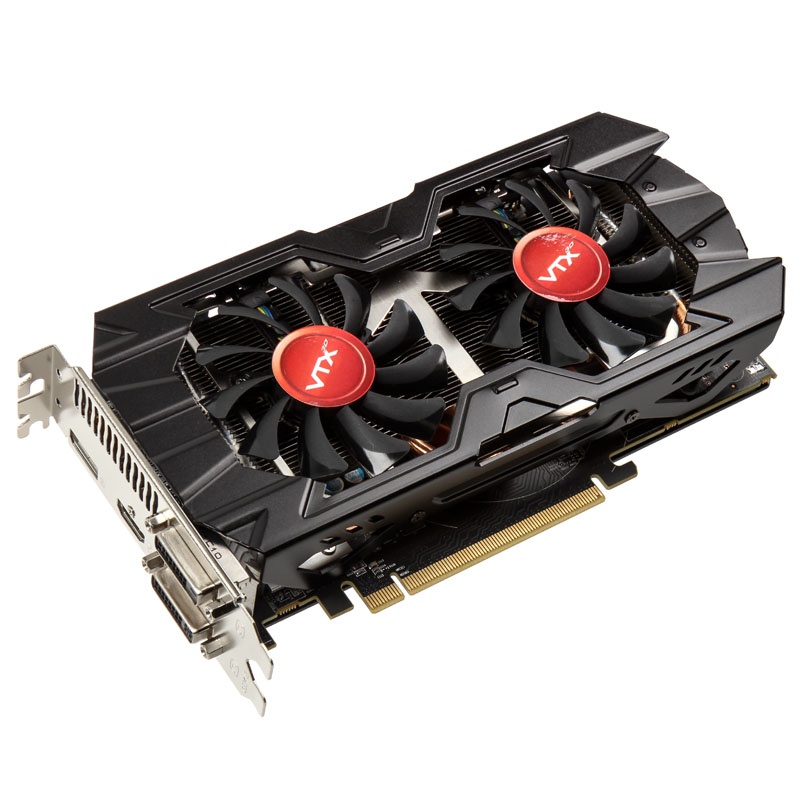
The Radeon R9 380 is the one model of the upper middle class. It has the Antigua – GPU, which on the known and very efficient Tonga – based GPU and just 1,792 shader units provides that communicate via a 256-bit memory interface with 2 gigabytes of GDDR5 memory , The clock of the GPU is the factory overclocked card from VTX3D at 1000 MHz, the memory operates at 2750 (effective 5500) MHz – thus, the Radeon R9 380 its predecessor, the R9 285, much in the shadows.
In order, despite the excellent performance, which is possible thanks to this technical equipment to enable a cool and quiet, VTX3D equips this variant of the Radeon R9 380 with a dual-slot cooler with two fans. Thus, the card is also very silent under full load, the more but idle – thanks to AMD Zero Core Power and AMD PowerPlay particularly much power is saved here.
The bandwidth for the exchange between video card and motherboard or CPU falls from high, because the R9 380 brings the current interface standard PCI Express 3.0 with up, whereby – given a suitable residual Hardware – the bandwidth over PCIe 2.0 to 16 GB / s doubles. Even otherwise, all modern standards are supported – DirectX 12, AMDs own Mantle API, DisplayPort, FreeSync and Ultra-HD / 4K resolutions are no foreign words for the R9 380 course.
In addition, the card thanks CrossFireX and Eyefinity is very flexible when it comes to support for multi-GPU setups and multiple screens. These can be controlled via two DVI and one HDMI port and one DisplayPort. Power is supplied via two 6-pin PCIe connectors, for operating a power supply with at least 500 watts is recommended. In order to exploit the full potential of the card in the future, new drivers should be downloaded and installed from AMD or VTX3D periodically.
Technical Details:
Height: 2 slot
GPU: AMD Radeon R9 380 (Antigua )
Production: 28 nm
GPU Clock: 970 MHz (Max. Boost)
Shader units: 1,792
Memory Size: 2048 MB
Memory clock: 2,750 (5,500) MHz
Type: GDDR5
Memory interface: 256-bit
Slot: PCIe x16 (PCIe / PCIe 2.x / PCIe 3.0)
Connections:
1 x DisplayPort 1.2a
1 x HDMI
1 x DVI-D (dual link)
1 x DVI-I (Dual Link)
Typical power consumption under load: 190 Watt
Power supply: 2 x 6-pin PCIe
Recommended power supply capacity: min. 500 Watt
Features: DirectX 12, OpenGL 4.5, OpenCL 2.1, Mantle, Eyefinity 2.0, CrossFireX, HD3D, True Audio, FreeSync